

ARTHUR ASHE HAS A DREAM FOR TENNIS : He’d like to see an athlete as talented as Michael Jordan playing tennis.

“When I was 12, I was the best player in Richmond (Va.),” Ashe, 44, recalled. “But I couldn’t prove it.
My coach decided that he was going to confirm it. We went to Bird Park, which was for whites only, where the USTA was holding its local tournament. The people knew who I was because I had built a reputation. But they said that I couldn’t play in the tournament because I was black.
“They weren’t mean or malicious. But you don’t forget something like that. My reaction was that I’d never let it happen again.”
…Ashe has a dream. He’d like to see an athlete as talented as Michael Jordan playing tennis.
Although tennis isn’t closed to blacks and other minorities, they often have a difficult time breaking into the sport because of the high cost of equipment and travel to tournaments.
“I’m sure Michael Jordan’s parents only had to buy him basketball shoes when he was growing up,” Ashe said. “But if you’re a tennis parent, you’re looking at $5,000 to $10,000 a year. Not too many people can afford that.”
When Jackie Robinson broke the color barrier in baseball, blacks flowed into the sport. The same thing happened in football and basketball.
“What we need is an American Yannick Noah,” Ashe said. “In many respects, I wasn’t a very good role model. We need someone who’s got flair and can play in-your-face tennis. And he should comport himself like Julius Erving.”
Ashe is disappointed that more blacks haven’t followed him into the game, and he’s trying to do something about it. He is the spokesman for a program designed to boost college tennis programs.
The program is a result of a United States Tennis Assn. study. The USTA, governing body of the sport in this country, commissioned a panel earlier this year to study ways to improve the game. “This was a watershed move for the USTA,” Ashe said.
“We (the U.S.) used to dominate tennis,” Ashe said. “The rest of the world had not caught up to us. We relied on individual effort to produce good players. We’ve never had a national mandate. This is the closest we have come to that.”
The new program will benefit college tennis programs all over the country, Ashe said, adding that he made sure small all-black colleges were included in the program.
Ashe said the system also is at least partly to blame for the current crop of tennis players who rant and rave on the court when faced with questionable calls.
“It’s difficult to maintain a sense of perspective when you walk on the court wearing $1,000 worth of tennis clothes and they didn’t cost you a dime,” Ashe said. “After a while, a player may start thinking that he or she is entitled to all this. The system has coddled the players and made them self-centered.”
Tennis players form their bad habits at an early age, Ashe said.
“When a player is 12-14 they’re local hotshots, and that continues until they’re 16-18. Then they go on the pro tour and nobody gives a . . . ,” Ashe said.
Ashe doesn’t miss playing tennis. In fact, he said, he hasn’t picked up a racket since heart problems prompted him to retire in 1980.
“If you play every day for 30 years, you don’t miss it.” he said.
Ashe’s biggest project, however, was his third book, “A Hard Road To Glory,” a history of black athletes in America. Ashe said that the book, due out in February, was a six-year project. It consists of three volumes, a 1,600 page-long set of records.
“It has anything you’d want to know about black athletes,” Ashe said. “For example, we have a list of every black baseball player who has ever played in the majors and the old Negro leagues.”
Ashe also compiled a list of black All-Americans in every collegiate sport at every school in the nation.
Ashe said he is not jealous of tennis players making big money today. “I made a lot of money,” he said. “I did extremely well. Certainly no more than a dozen players on the tour make more money than I do now and I haven’t played tennis in seven years.”
His outlook on life changed as a result of his heart problems.
“For some people, the future is next year,” Ashe said. “But for me it’s this afternoon.”
https://www.latimes.com/archives/la-xpm-1987-09-29-sp-10872-story.html (https://www.latimes.com/archives/la-xpm-1987-09-29-sp-10872-story.html)
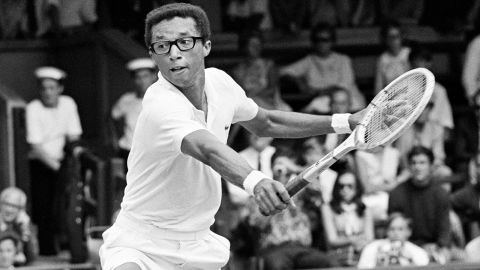
Ed Lacey/Popperfoto/Getty Images
Pictures: Tennis great Arthur Ashe | CNN (https://www.cnn.com/2022/06/13/tennis/gallery/arthur-ashe-life-in-pictures-origseries/index.html)
 Connect the Dots 101
Leave a comment