
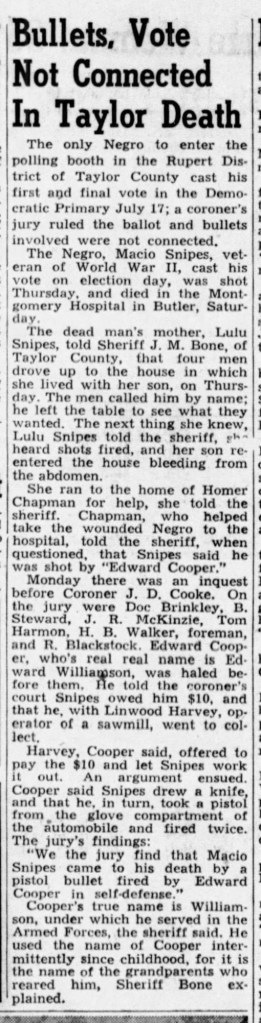
On July 18, 1946, a white mob shot a 37-year-old Black veteran named Maceo Snipes at his home in Butler, Georgia. A day earlier, Mr. Snipes had exercised his constitutional right to vote in the Georgia Democratic Primary, becoming the only Black man to vote in the election in Taylor County. For this he was targeted and lynched.
Mr. Snipes had served in the U.S. Army for two and a half years during World War II and, after receiving an honorable discharge, had returned home to Taylor County, Georgia, to work as a sharecropper with his mother. Mr. Snipes’s family later recalled that he had received threats from the Ku Klux Klan in the days leading up to the election, but he still bravely went to vote in the gubernatorial primary on July 17, 1946.
Just two years before, the U.S. Supreme Court’s decision in Smith v. Allwright had ruled it unconstitutional for political parties to hold “all-white primaries,” in which only white voters were permitted to participate in choosing the party’s candidate. This established that Mr. Snipes and other Black people were legally entitled to vote in the primary, but many white Georgians resented the ruling—including candidate Eugene Talmadge, who campaigned on a promise to restore white primaries in the state. A staunch white supremacist, Mr. Talmadge had been previously elected governor of Georgia on three occasions with a segregationist platform and the open support of white terrorism groups, including the Ku Klux Klan. “The South loves the Negro in his place,” Mr. Talmadge had said in a 1942 campaign speech, “but his place is at the back door.”
When the primary concluded, Mr. Talmadge had won the party’s nomination and received the most support in rural areas. When Taylor County votes were tallied, Mr. Talmadge had won all but one vote—and white community members believed that Mr. Snipes, known to be the only Black voter in the county, had cast that lone vote of opposition.
A day after the primary, a mob of white men, including a white veteran named Edward Williamson, arrived at Mr. Snipes’s grandfather’s house in a pickup truck and called out Mr. Snipes’s name. Mr. Snipes got up from the table where he was eating dinner with his mother and went outside to see who was there, only to be shot multiple times at his own front door. The truck of men then drove away.
Severely wounded and assisted by his mother, Mr. Snipes walked for several miles searching for help before he was finally transported to a hospital in Butler and admitted for care. According to his family, the hospital’s segregation policies delayed Mr. Snipes’s treatment for several hours; relatives later recounted that a doctor told them Mr. Snipes urgently needed a blood transfusion but could not get one because the hospital did not have any “Black blood” to use. Two days later, on July 20, 1946, Mr. Snipes died.
https://calendar.eji.org/racial-injustice/jul/18
 Connect the Dots 101
Leave a comment