
(Alphabetical by title)
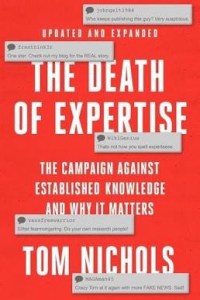
The Death of Expertise, Tom Nichols
The Death of Expertise, Tom Nicholas
Ministry of Truth, Steve Benen
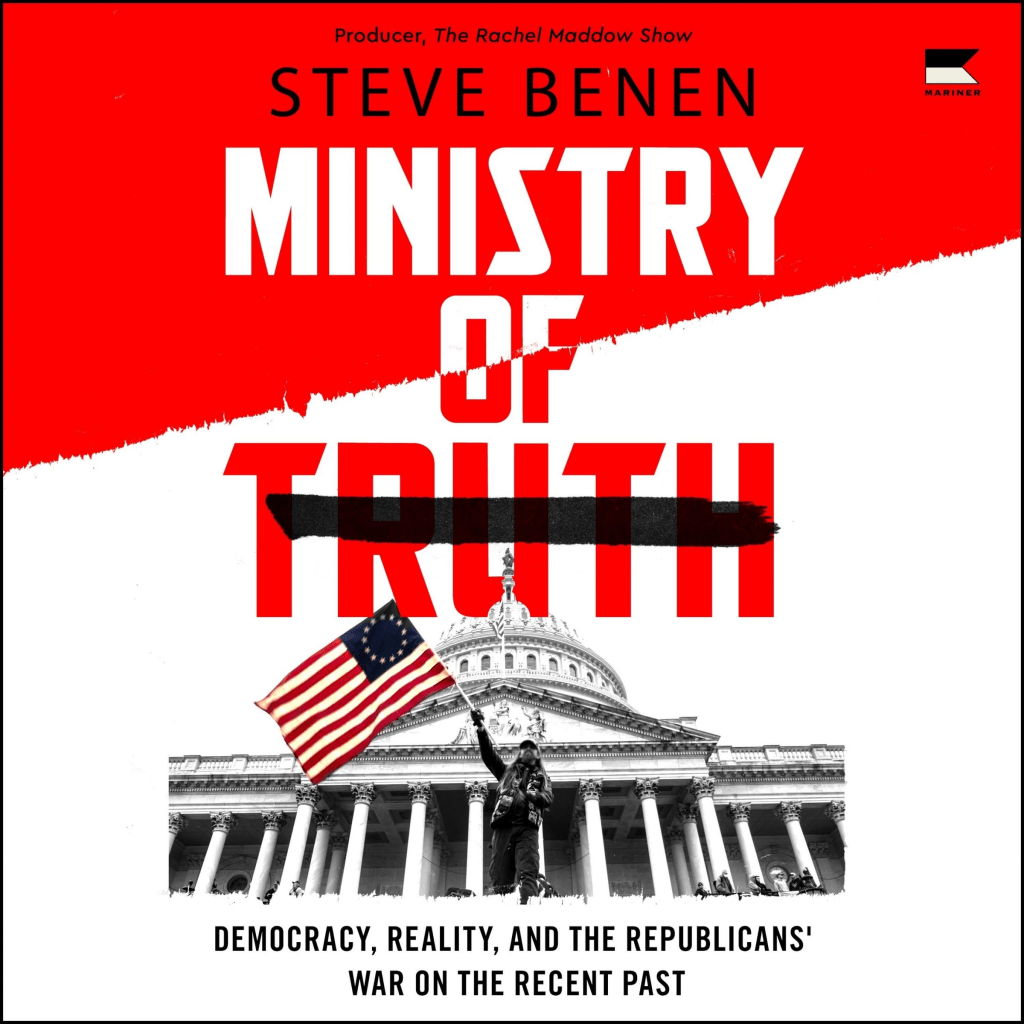
The Republican Party is waging a “frantic gaslighting campaign” to “rewrite the stories that have unfolded over the last several years,” according to this illuminating account from Benen (The Impostors), a producer of The Rachel Maddow Show. Pointing to polls showing that “a majority of Republican voters [believe] that Trump made no effort to overturn the 2020 election,” among other misbeliefs that absolve Donald Trump from wrongdoing and exaggerate his successes as president, Benen delves into how the Republican playbook of “historical revisionism” has evolved in recent years to make such lies possible to perpetuate.
https://www.publishersweekly.com/9780063393677
Murder the Truth, David Enrich

Murder the Truth, by David Enrich
“Murder the Truth” by David Enrich is an investigative journalism book that exposes a concerted campaign by powerful individuals and political groups to strategically use lawsuits and legal threats to intimidate and silence journalists, effectively “murdering the truth” by suppressing critical reporting and undermining the First Amendment.
Key points of the synopsis:
- Focus on legal tactics: The book details how wealthy individuals and conservative organizations utilize expensive defamation lawsuits, even when they have little merit, to financially cripple news outlets and deter them from publishing investigative pieces that could be damaging to their interests.
- Threat to democracy:Enrich argues that this strategy of “strategic lawsuits against public participation” (SLAPPs) is a serious threat to democratic accountability, as it creates a chilling effect on free speech and discourages journalists from reporting on controversial topics.
- Political context: The book examines how this trend has been amplified in the era of Donald Trump, where attacks on the media were prevalent and the rhetoric of “fake news” was used to discredit legitimate reporting.
- Impact on journalism: Enrich explores the real-world consequences of this campaign, including the closure of smaller news organizations, self-censorship by journalists, and a decline in public trust in the media.
Overall, “Murder the Truth” serves as a warning about the growing threat to investigative journalism and the potential for powerful entities to manipulate the legal system to suppress critical reporting and obstruct public access to information.
(AI-generated)
On Tyranny, Timothy Snyder
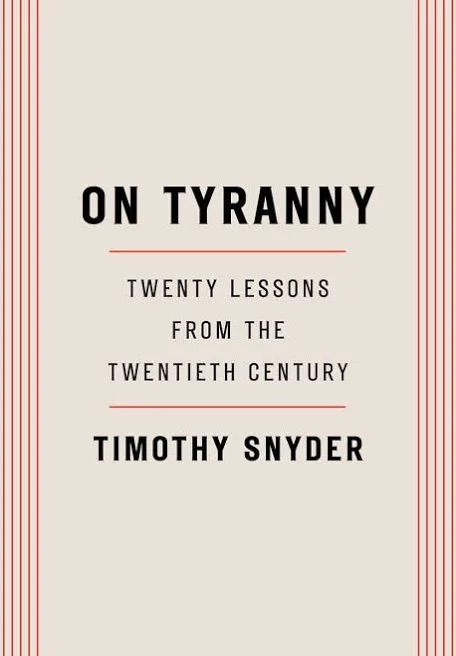
#1 NEW YORK TIMES BESTSELLER • A “bracing” (Vox)guide for surviving and resisting America’s turn towards authoritarianism, from “a rising public intellectual* unafraid to make bold connections between past and present” (The New York Times)
“Timothy Snyder reasons with unparalleled clarity, throwing the past and future into sharp relief. He has written the rare kind of book that can be read in one sitting but will keep you coming back to help regain your bearings.”—Masha Gessen
The Founding Fathers tried to protect us from the threat they knew, the tyranny that overcame ancient democracy. Today, our political order faces new threats, not unlike the totalitarianism of the twentieth century. We are no wiser than the Europeans who saw democracy yield to fascism, Nazism, or communism. Our one advantage is that we might learn from their experience.
On Tyranny is a call to arms and a guide to resistance, with invaluable ideas for how we can preserve our freedoms in the uncertain years to come.
*Timothy Snyder is senior fellow for democracy at the Council on Foreign Relations (CFR). He is also the Richard C. Levin Professor of History at Yale University, where he teaches courses on modern Eastern European political history, the Holocaust, Eastern European history as global history, and the dynamics of international crises in European political history. He is also a permanent fellow at the Institute for Human Sciences in Vienna.
https://timothysnyder.org/on-tyranny
Teaching White Supremacy, Donald Yacovone
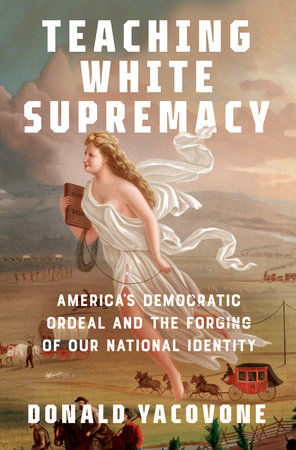
Teaching White Supremacy reveals in great detail the battle over historical memory in public schools and how the white elite has devoted extraordinary resources to perpetuating racist ideas in each generation through the K-12 curriculum. As Yacovone notes, in 1932 the NAACP warned that public schools are a “breeding ground for bigotry and prejudice” and “textbooks are often germ carriers of the most vicious [anti-Black] propaganda.”
https://www.zinnedproject.org/materials/teaching-white-supremacy
Who is Government? Michael Lewis
Who is Government? The Untold Story of Public Service, Michael Lewis
“Who Is Government?,” edited by Michael Lewis, is filled with examples of what the federal government does and why it is vital to American life….“Who Is Government?,” edited by Michael Lewis, is filled with examples of what the federal government does and why it is vital to American life. Page after page, the book breaks down the cynical caricature of the federal government that has persisted over the years and been amplified in recent months. It shows that far from being riddled with and corrupted by waste, fraud, abuse and laziness, the federal government is (or was) filled with people working hard — people painfully aware that they’re stewarding government resources, doing so artfully under tight constraints, all of whom could be doing something for more money elsewhere.
https://www.washingtonpost.com/books/2025/03/20/who-is-government-michael-lewis-book-review/
Without Sanctuary
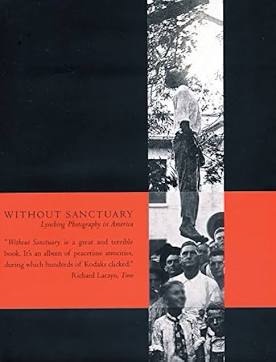
Due process.
A book published this month, ”Without Sanctuary: Lynching Photography in America” reproduces 98 images from the collection…that [goes] on view tomorrow at Roth Horowitz, a gallery on the Upper East Side…
[They] are of American lynchings that took place between 1883 and 1960, mostly but not always in the South. Most of them were taken by professional photographers immediately or a short while after the lynching, sometimes during. All but a few of the victims were African-American men and women….
These images, most of which are postcard-size, are incendiary; they will burn a hole in your heart. They depict the lifeless forms of black men and women hanging from trees, bridges, from telegraph poles, often tortured or mutilated. They depict charred corpses held aloft like banners and relatively intact ones arranged like hunting trophies.
They are postcard-size because that is what they were: most of them original photographic postcards and a few printed halftones (some hand-tinted) that were produced in the hundreds and occasionally the thousands and sent through the mail, sometimes as warnings (until around 1908, when the Postmaster General of the United States forbade the sending of such material). Some bear personal inscriptions: ”This is the barbecue we had last night. My picture is to the left with a cross over it, your sone (sic) Joe,” reads one message.…
But as Mr. Allen observes in his eloquent afterword, it is not so much the victims that stun, although of course they do. What takes the breath away is the sight of all the white people, maskless, milling about, looking straight at the camera as if they had nothing to be ashamed of, often smiling. Sometimes they line up in an orderly fashion, as if they were at a class reunion or church picnic. Sometimes they cluster around the victim, hoisting children on their shoulders so that they can see too.
Sometimes the camera has pulled back for a long view, so that one sees only immense seas of white people filling the image edge to edge. One such image has a wide black smudge, flaring like a funnel from center to upper edge, that on first sight appears to be a stain on either the print or the negative. Then you realize that the smudge is billowing, and that its source, which holds the crowd rapt, is someone being burned alive.
Historians have also detailed the carnival atmosphere and the social ritual of a lynching, which was often announced in advance and drew thousands of people from the surrounding area. And they have reported that people in the crowds often took part in the torture and then scrambled afterwards to get bits of cloth or bone as souvenirs.
But the images at Roth Horowitz instigate a deeper, more visceral experience of knowing history. It is one thing to read that some lynchings were publicized beforehand, another to see firsthand evidence. One of the most chilling nonphotographic exhibits at Roth Horowitz is a pamphlet published by the N.A.A.C.P. with a facsimile of the front page of The Memphis Press, Jan. 26, 1921: ”May Lynch 3 to 6 Negroes This Evening.”
Similarly, the often intense fetishization of the victim, the desire for what are in effect relics, is concretized by an image of a lynching displayed as Mr. Allen purchased it, framed under glass with several strands of the victim’s hair.
The collection records the effects of fear and ignorance translated into mindless hate and taken to heinous conclusions….
It also reminds us that such unexamined fear projected outward as hatred is still very present in American society in phenomena that range from the dragging death of James Byrd Jr. near Jasper, Tex., in 1998, to the difficulty black men face trying to hail cabs in New York City. Mr. Als makes this clear in his essay when he writes, ”In my life as a city dweller, I have crossed dark nighttime streets so as not to make the white woman walking in front of me feel fear. . . . What I mean is that so much care, so much care is taken not to scare white people simply with my existence…
Horrific as they are, these photographs are a kind of gift, the gift of knowledge, the chance for greater consciousness and caring. That they were made so openly reflects the unquestioning presumption of white supremacy but also preserves that presumption in all its brutality for us to know anew.
One exhibit at Roth Horowitz provides a glimmer of what these photographs might mean for the future. It is a photograph of Frank Embree standing on the back of a buggy, naked and chained, shortly before his death in Fayette, Mo., on July 22, 1899. He has been severely whipped and the camera records the deep lacerations up and down his body. But it also records his insuperable dignity and his eyes, which look down at the camera and directly into the lens, oblivious of the leering white men who crowd into the picture.
Mr. Als writes that Embree’s eyes are dead, but it seems equally arguable that they know death is coming. Their narrow, exclusive focus gives them a flicker of life. Embree looks into the camera as if into the future, as if he knows that the camera will ultimately betray the men around him and let the world know his fate.
[Review continues of the exhibit from which the book was derived.]
 Connect the Dots 101